

How To Repair Vinyl Lattice In Windows Panel
Various examples of windows
A window is an opening in a wall, door, roof, or vehicle that allows the exchange of light and may also allow the passage of audio and sometimes air. Modern windows are commonly glazed or covered in another transparent or translucent material, a sash set in a frame[one] in the opening; the sash and frame are also referred to as a window.[2] Many glazed windows may be opened, to allow ventilation, or closed, to exclude choppy weather. Windows may have a latch or similar mechanism to lock the window shut or to hold it open past diverse amounts.
In addition to this, many modern twenty-four hour period windows may have a window screen or mesh, oftentimes fabricated of aluminum or fibreglass, to keep bugs out when the window is opened.
Types include the countenance window, fixed windows, hexagonal windows, single-hung, and double-hung sash windows, horizontal sliding sash windows, casement windows, awning windows, hopper windows, tilt, and slide windows (often door-sized), tilt and turn windows, transom windows, sidelight windows, jalousie or louvered windows, clerestory windows, lancet windows, skylights, roof windows, roof lanterns, bay windows, oriel windows, thermal, or Diocletian, windows, picture windows, Rose windows, emergency leave windows, stained glass windows, French windows, panel windows, double/triple-paned windows, and witch windows.
The Romans were the kickoff known to use drinking glass for windows, a technology probable showtime produced in Roman Egypt, in Alexandria c. 100 AD. Paper windows were economical and widely used in ancient China, Korea, and Nippon. In England, glass became common in the windows of ordinary homes only in the early 17th century whereas windows fabricated upwardly of panes of flattened creature horn were used as early as the 14th century. In the 19th century American west, greased paper windows came to be used by itinerant groups. Modern-style floor-to-ceiling windows became possible merely later on the industrial plate glass making processes were fully perfected.
Etymology [edit]
The English language-give-and-take window originates from the Old Norse vindauga , from vindr 'wind' and auga 'eye'.[3] In Norwegian, Nynorsk, and Icelandic, the Sometime Norse form has survived to this day (in Icelandic only every bit a less used word for a blazon of small open up "window", non strictly a synonym for gluggi , the Icelandic give-and-take for 'window'[4]). In Swedish, the discussion vindöga remains as a term for a pigsty through the roof of a hut, and in the Danish language vindue and Norwegian Bokmål vindu , the straight link to eye is lost, just as for window. The Danish (simply non the Bokmål ) discussion is pronounced adequately similarly to window.
Window is first recorded in the early 13th century, and originally referred to an unglazed pigsty in a roof. Window replaced the Old English eagþyrl , which literally means 'middle-pigsty', and eagduru 'eye-door'. Many Germanic languages, all the same, adopted the Latin give-and-take fenestra to describe a window with glass, such equally standard Swedish fönster , or German Fenster . The use of window in English is probably considering of the Scandinavian influence on the English language by means of loanwords during the Viking Age. In English language, the word fenester was used as a parallel until the mid-18th century. Fenestration is all the same used to depict the arrangement of windows within a façade, likewise every bit defenestration, meaning 'to throw out of a window'.
History [edit]

Alabaster "mullion"-divided decorative windows in Santa Maria La Major church (Morella, Spain)
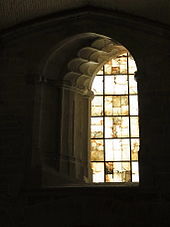
Alabaster window in the Valencia Cathedral. Note the asymmetrical, slanted left side of the wall-frame, which lets sun rays reach the chancel
In the 13th century BC, the earliest windows were unglazed openings in a roof to admit lite during the day. Afterward,[ when? ] windows were covered with animal hide, cloth, or woods. Shutters that could be opened and closed came adjacent.[ when? ] Over time, windows were built that both protected the inhabitants from the elements and transmitted light, using multiple small pieces of translucent material, such as flattened pieces of translucent beast horn, thin slices of marble, for example, fengite, or pieces of glass, set in frameworks of wood, fe or lead. In the Far East, paper was used to fill windows.[one] The Romans were the start known to apply drinking glass for windows, a technology likely first produced in Roman Egypt. Namely, in Alexandria ca. 100 AD cast drinking glass windows, albeit with poor optical backdrop, began to appear, simply these were small thick productions, footling more than blown glass jars (cylindrical shapes) flattened out into sheets with circular striation patterns throughout. It would be over a millennium before a window glass became transparent enough to run into through clearly, as we think of it now.
Over the centuries techniques were adult to shear through one side of a blown glass cylinder and produce thinner rectangular window panes from the aforementioned amount of glass material. This gave ascent to alpine narrow windows, unremarkably separated by a vertical support chosen a mullion. Mullioned glass windows were the windows of option among European well-to-do, whereas paper windows were economical and widely used in aboriginal Prc, Korea, and Japan. In England, glass became common in the windows of ordinary homes only in the early 17th century whereas windows made up of panes of flattened animate being horn were used as early on as the 14th century.[v]
Modern-style flooring-to-ceiling windows became possible only after the industrial plate glass making processes were perfected. Modern windows are usually filled with glass, although a few are transparent plastic.[1]
- Brusk visual history of windows
-

-

Fragment of a Roman window drinking glass plate dated to 1st to 4th century Ad. Note the obvious curvature; this is non a flat pane
-

-

-

-

-

-

-

-

-

Gothic Revival window of a house on Strada Jean-Louis Calderon (Bucharest)
-
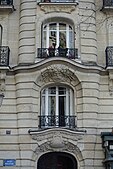
19th century Eclectic Classicist windows on Rue Molitor (Paris)
-

Beaux-Arts window of the Stroescu House on Strada Dianei (Bucharest)
-

Postmodern windows of the Cité de la musique (Paris)
-

-

Very loftier windows in the entrance to a residential building in Ystad.
Types [edit]
Cantankerous [edit]
A cross-window is a rectangular window usually divided into four lights by a mullion and transom that form a Latin cross.[vi]
Eyebrow [edit]
The term eyebrow window is used in ii ways: a curved peak window in a wall or an eyebrow dormer; and a row of small windows unremarkably under the front end eaves such as the James-Lorah House in Pennsylvania.[seven]
Fixed [edit]
A fixed window is a window that cannot exist opened,[viii] whose function is limited to allowing light to enter (unlike an unfixed window, which tin can open up and close). Clerestory windows in church building compages are frequently fixed. Transom windows may be stock-still or operable. This blazon of window is used in situations where light or vision alone is needed every bit no ventilation is possible in such windows without the use of trickle vents or overglass vents.
Single-hung sash [edit]
A single-hung sash window is a window that has one sash that is movable (normally the bottom i) and the other fixed. This is the earlier form of sliding sash window and is besides cheaper.[one]
Double-hung sash [edit]

A sash window is the traditional style of window in the United kingdom, and many other places that were formerly colonized by the UK, with two parts (sashes) that overlap slightly and slide up and downwards within the frame. The 2 parts are not necessarily the aforementioned size; where the upper sash is smaller (shorter) it is termed a cottage window. Currently, most new double-hung sash windows use spring balances to support the sashes, just traditionally, counterweights held in boxes on either side of the window were used. These were and are fastened to the sashes using pulleys of either braided string or, later, purpose-made chain. 3 types of spring balances are called a tape or clock spring residual; channel or block-and-tackle remainder, and a spiral or tube residual.
Double-hung sash windows were traditionally frequently fitted with shutters. Sash windows tin can be fitted with simplex hinges that let the window be locked into hinges on one side, while the rope on the other side is detached—so the window tin be opened for fire escape or cleaning.
Foldup [edit]
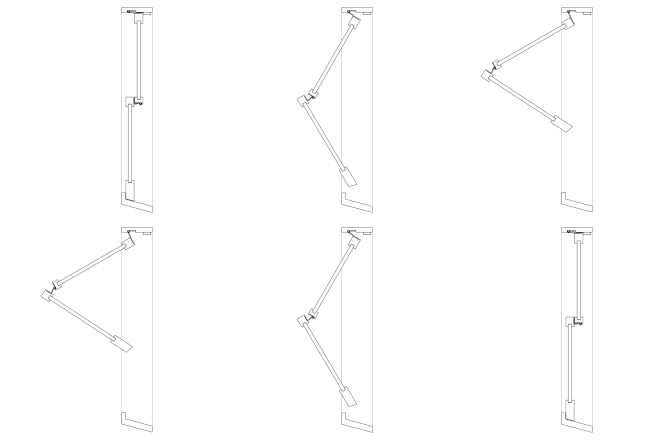
Foldup window (inward swinging), cantankerous-department side view
A foldup has ii equal sashes similar to a standard double-hung only folds upward allowing air to pass through nearly the total-frame opening. The window is balanced using either springs or counterbalances, like to a double-hung. The sashes can be either offset to simulate a double-hung, or in-line. The inline versions can exist fabricated to fold inwards or outward. The inward swinging foldup windows tin take stock-still screens, while the outward swinging ones crave movable screens. The windows are typically used for screen rooms, kitchen laissez passer-throughs, or egress.
Horizontal sliding sash [edit]
A horizontal sliding sash window has 2 or more than sashes that overlap slightly simply slide horizontally within the frame. In the Uk, these are sometimes called Yorkshire sash windows, presumably because of their traditional use in that canton.
Casement [edit]

A casement window is a window with a hinged sash that swings in or out like a door comprising either a side-hung, pinnacle-hung (as well called "awning window"; see below), or occasionally bottom-hung sash or a combination of these types, sometimes with stock-still panels on one or more sides of the sash.[2] In the US, these are usually opened using a crank, but in parts of Europe, they tend to employ projection friction stays and espagnolette locking. Formerly, plain hinges were used with a casement stay. Handing applies to casement windows to decide direction of swing; a casement window may be left-handed, correct-handed, or double. The casement window is the dominant type now found in modern buildings in the UK and many other parts of Europe.
Awning [edit]

An awning window is a casement window that is hung horizontally, hinged on elevation, so that it swings outward like an awning. In addition to being used independently, they can exist stacked, several in i opening, or combined with fixed drinking glass. They are particularly useful for ventilation.[9]
Hopper [edit]
A hopper window is a lesser-pivoting casement window that opens past tilting vertically, typically to the inside, resembling a hopper chute.[x]
Pivot [edit]
A pivot window is a window hung on i hinge on each of two opposite sides which allows the window to revolve when opened. The hinges may be mounted height and bottom (Vertically Pivoted) or at each jamb (Horizontally Pivoted). The window will usually open initially to a restricted position for ventilation and, once released, fully contrary and lock once again for safe cleaning from within. Modern pivot hinges incorporate a friction device to hold the window open up against its weight and may have brake and reversed locking congenital-in. In the UK, where this type of window is most common, they were extensively installed in high-ascension social housing.
Tilt and slide [edit]
A tilt and slide window is a window (more usually a door-sized window) where the sash tilts inwards at the summit similar to a hopper window and so slides horizontally behind the fixed pane.
Tilt and turn [edit]
A tilt and plough window tin can both tilt inwards at the top or open up inward from hinges at the side. This is the most mutual type of window in Germany, its land of origin. It is also widespread in many other European countries. In Europe, information technology is usual for these to be of the "plow commencement" type. i.e. when the handle is turned to 90 degrees the window opens in the side hung mode. With the handle turned to 180 degrees the window opens in bottom hung style. Most usually in the United kingdom the windows will be "tilt first" i.east. bottom hung at 90 degrees for ventilation and side hung at 180 degrees for cleaning the outer face of the drinking glass from inside the edifice.[xi]
Transom [edit]
A window above a door; in an exterior door the transom window is often stock-still, in an interior door, it can open up either by hinges at top or lesser, or rotate on hinges. It provided ventilation before forced air heating and cooling. A fan-shaped transom is known every bit a fanlight, especially in the British Isles.
Side light [edit]
Windows beside a door or window are called side-, wing-, margen-lights, and flanking windows.[12]

Jalousie window [edit]
Too known equally a louvered window, the jalousie window consists of parallel slats of glass or acrylic that open and close like a Venetian blind, usually using a crank or a lever. They are used extensively in tropical architecture. A jalousie door is a door with a jalousie window.
Clerestory [edit]

A clerestory window is a window set in a roof structure or high in a wall, used for daylighting.
Skylight [edit]

A skylight is a window built into a roof structure.[xiii] This blazon of window allows for natural daylight and moonlight.
Roof [edit]

A sloped window used for daylighting, congenital into a roof structure. It is one of the few windows that could be used equally an exit. Larger roof windows meet building codes for emergency evacuation.
Roof lantern [edit]
A roof lantern is a multi-paned drinking glass construction, resembling a minor edifice, built on a roof for mean solar day or moon light. Sometimes includes an additional clerestory. May also be called a cupola.
Bay [edit]

A bay window is a multi-console window, with at least three panels set at different angles to create a protrusion from the wall line.[ii]
Oriel [edit]
This form of bay window most often appears in Tudor-way houses and monasteries. It projects from the wall and does not extend to the footing. Originally a form of porch, they are often supported by brackets or corbels.
Thermal [edit]
Thermal, or Diocletian, windows are large semicircular windows (or niches) which are ordinarily divided into three lights (window compartments) by two mullions. The key compartment is often wider than the two side lights on either side of it.
Picture [edit]
A film window is a large stock-still window in a wall, typically without glazing bars, or glazed with only perfunctory glazing bars (muntins) near the edge of the window. Picture windows provide an unimpeded view, equally if framing a moving-picture show.[xiv]
Multi-lite [edit]
A multi-lite window is a window glazed with small panes of glass separated past wooden or lead glazing confined, or muntins, arranged in a decorative glazing pattern often dictated by the building's architectural style. Due to the historic unavailability of large panes of glass, the multi-lit (or lattice window) was the most common window style until the beginning of the 20th century, and is however used in traditional architecture.
Emergency exit/egress [edit]
An emergency leave window is a window large enough and low enough and so that occupants can escape through the opening in an emergency, such every bit a fire. In many countries, exact specifications for emergency windows in bedrooms are given in many building codes. Specifications for such windows may also allow for the archway of emergency rescuers. Vehicles, such as buses and aircraft, frequently have emergency get out windows as well.[15]
Stained glass [edit]

A stained glass window is a window composed of pieces of colored glass, transparent, translucent or opaque, frequently portraying persons or scenes. Typically the glass in these windows is separated by pb glazing confined. Stained glass windows were pop in Victorian houses and some Wrightian houses, and are especially common in churches.[sixteen]
French [edit]

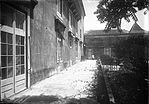
A "French window" (ii French doors on an exterior wall hinged to open up outward together without a mullion separating them) at the Embassy of France in Lisbon, early 20th century.
A French door[17] has two rows of upright rectangular glass panes (lights) extending its full length; and two of these doors on an exterior wall and without a mullion separating them, that open outward with opposing hinges to a terrace or porch, are referred to as a French window.[eighteen] Sometimes these are prepare in pairs or multiples thereof along the exterior wall of a very big room, only often, one French window is placed centrally in a typically sized room, possibly among other fixed windows flanking the feature. French windows are known as porte-fenêtre in French republic and portafinestra in Italian republic, and ofttimes are used in modern houses.
Double-paned [edit]

Double Panel windows as well sometimes called dual pane windows, are windows that have 2 panes of glass inset into the frame of the window. The panes of drinking glass are separated, creating an insulating air pocket that inhibits oestrus transfer much improve than single pane windows
Double-paned windows have 2 parallel panes (slabs of glass) with a separation of typically about 1 cm; this space is permanently sealed and filled at the time of manufacture with dry air or other dry nonreactive gas. Such windows provide a marked comeback in thermal insulation (and usually in acoustic insulation also) and are resistant to fogging and frosting caused by temperature differential. They are widely used for residential and commercial structure in intemperate climates. In the U.k., double-paned and triple-paned are referred to as double-glazing and triple-glazing. Triple-paned windows are now a common blazon of glazing in central to northern Europe. Quadruple glazing is now being introduced in Scandinavia.
Hexagonal window [edit]

A hexagonal window is a hexagon-shaped window, resembling a bee cell or crystal lattice of graphite. The window can exist vertically or horizontally oriented, openable or expressionless. Information technology can also be regular or elongately-shaped and tin can have a separator (mullion). Typically, the cellular window is used for an attic or as a decorative feature, but it can also be a major architectural element to provide the natural lighting inside buildings.
Guillotine window [edit]
A guillotine window is a window that opens vertically. The guillotine windows are opening from lesser to top or from top to bottom with more one sliding frames. The remote control can be used to open and close guillotine windows.
Terms [edit]
EN 12519 is the European standard that describes windows terms officially used in Eu Member States. The main terms are:

- Light, or Lite, is the expanse between the outer parts of a window (transom, sill and jambs), unremarkably filled with a drinking glass pane. Multiple panes are divided past mullions when load-begetting, muntins when not.[19]
- Lattice low-cal is a compound window pane madeup of small-scale pieces of glass held together in a lattice.
- Stock-still window is a unit of one not-moving lite. The terms single-lite, double-calorie-free, etc., refer to the number of these drinking glass panes in a window.
- Sash unit is a window consisting of at to the lowest degree one sliding glass component, typically composed of two lites (known as a double-calorie-free).
- Replacement window in the United states means a framed window designed to slip within the original window frame from the inside afterward the old sashes are removed. In Europe, it unremarkably means a complete window including a replacement outer frame.
- New construction window, in the U.s.a., ways a window with a nailing fin that is inserted into a rough opening from the exterior before applying siding and inside trim. A nailing fin is a project on the outer frame of the window in the same aeroplane as the glazing, which overlaps the prepared opening, and tin thus be 'nailed' into place.
- In the UK and mainland Europe, windows in new-build houses are ordinarily stock-still with long screws into expanding plastic plugs in the brickwork. A gap of upward to 13 mm is left effectually all four sides, and filled with expanding polyurethane foam. This makes the window fixing weatherproof but allows for expansion due to heat.
- Lintel is a beam over the top of a window, as well known as a transom.
- Window sill is the bottom piece in a window frame. Window sills camber outward to drain water away from the within of the edifice.
- Secondary glazing is an boosted frame applied to the inside of an existing frame, usually used on protected or listed buildings to achieve higher levels of thermal and sound insulation without compromising the wait of the building
- Decorative millwork is the moulding, cornices and lintels often decorating the surrounding edges of the window.
Labeling [edit]
The United States NFRC Window Label lists the following terms:
- Thermal transmittance (U-factor), best values are effectually U-0.15 (equal to 0.eight W/m2/Thou)
- Solar heat gain coefficient (SHGC), ratio of solar oestrus (infrared) passing through the glass to incident solar heat
- Visible transmittance (VT), ratio of transmitted visible lite divided by incident visible light
- Air leakage (AL), measured in cubic foot per minute per linear foot of scissure between sash and frame
- Condensation resistance (CR), measured between 1 and 100 (the college the number, the higher the resistance of the formation of condensation)[twenty]
The European harmonised standard hEN 14351–i, which deals with doors and windows, defines 23 characteristics (divided into essential and not essential). Ii other, preliminary European Norms that are under evolution deal with internal pedestrian doors (prEN 14351–2), smoke and burn resisting doors, and openable windows (prEN 16034).[21]
Structure [edit]


five-sleeping accommodation plastic window profile
Windows can be a significant source of heat transfer.[22] Therefore, insulated glazing units consist of two or more than panes to reduce the transfer of heat.
Grids or muntins [edit]
These are the pieces of framing that divide a larger window into smaller panes. In older windows, large panes of glass were quite expensive, and so muntins permit smaller panes fill a larger infinite. In mod windows, light-colored muntins withal provide a useful function by reflecting some of the light going through the window, making the window itself a source of diffuse lite (instead of just the surfaces and objects illuminated within the room). By increasing the indirect illumination of surfaces near the window, muntins tend to burnish the area immediately around a window and reduce the contrast of shadows within the room.
Frame and sash construction [edit]
Frames and sashes can exist fabricated of the following materials:
| Material | Thermal resistance | Durability | Maintenance | Toll | Recycled content | Comment |
|---|---|---|---|---|---|---|
| Forest | very skillful | variable | low | average | high | a well-maintained wood window built earlier 1950 tin can last fifty–100 years[23] [24] |
| uPVC ("vinyl") | very good | very good[i] | very depression | average | very low | has a life span of 25–l years in average[24] |
| Aluminum | very expert[ii] | good | very low | depression | typically > 95% | mostly thermally broken by a thermal insulation contour |
| Composites | very proficient | good | very low | loftier | loftier | used in modern buildings |
| Steel | medium | superior | very low | loftier | > 98% | typically welded at corner joints |
| Fiberglass | very good | very practiced[i] | very low | high | medium |
- ^ a b PVC and fiberglass frames perform well in accelerated weathering tests. Because PVC is not every bit strong as other materials, some PVC frames are reinforced with metal or composite materials to improve their structural forcefulness.
- ^ Modern aluminium window frames are typically separated by a thermal break made of a glass fibre reinforced polyamide. With a 34 mm thermal insulation profile it is possible to reach Uf= 1.iii W/m2K for a metallic window. This greatly increases thermal resistance, while retaining virtually all of the structural strength.
Composites (too known as Hybrid Windows) are start since early 1998 and combine materials like aluminium + pvc or wood to obtain aesthetics of 1 material with the functional benefits of another.
A typical installation of insulated glazing windows with uPVC window frames.
A special form of PVC window frames, uPVC window frames, became widespread since the late 20th century, peculiarly in Europe: there were 83.5 million installed by 1998[25] with numbers still growing every bit of 2022.[26]
Glazing and filling [edit]
Depression-emissivity coated panes reduce heat transfer by radiation, which, depending on which surface is coated, helps prevent heat loss (in cold climates) or heat gains (in warm climates).
High thermal resistance can be obtained by evacuating or filling the insulated glazing units with gases such as argon or krypton, which reduces conductive estrus transfer due to their depression thermal electrical conductivity. Performance of such units depends on good window seals and meticulous frame construction to prevent entry of air and loss of efficiency.
Modern double-pane and triple-pane windows often include i or more low-east coatings to reduce the window's U-gene (its insulation value, specifically its rate of heat loss). In general, soft-coat low-eastward coatings tend to effect in a lower solar oestrus gain coefficient (SHGC) than hard-coat low-e coatings.
Modernistic windows are usually glazed with one large sail of glass per sash, while windows in the past were glazed with multiple panes separated by glazing bars, or muntins, due to the unavailability of large sheets of glass. Today, glazing confined tend to be decorative, separating windows into small-scale panes of drinking glass even though larger panes of glass are available, generally in a design dictated by the architectural manner at use. Glazing bars are typically wooden, only occasionally lead glazing bars soldered in place are used for more than intricate glazing patterns.
Other construction details [edit]
Many windows have movable window coverings such as blinds or defunction to keep out light, provide additional insulation, or ensure privacy. Windows permit natural low-cal to enter, merely too much can have negative effects such as glare and rut gain. Additionally, while windows let the user see exterior, in that location must be a way to maintain privacy on in the inside.[27] Window coverings are practical accommodations for these issues.
Impact of the dominicus [edit]
Sun incidence angle [edit]
Historically, windows are designed with surfaces parallel to vertical building walls. Such a design allows considerable solar light and rut penetration due to the about ordinarily occurring incidence of sun angles. In passive solar building pattern, an extended eave is typically used to control the amount of solar light and heat inbound the window(s).
An alternative method is to calculate an optimum window mounting angle that accounts for summertime sun load minimization, with consideration of actual latitude of the edifice. This process has been implemented, for example, in the Dakin Building in Brisbane, California—in which most of the fenestration is designed to reflect summertime heat load and aid prevent summer interior over-illumination and glare, past canting windows to nearly a 45 caste angle.
Solar window [edit]
Photovoltaic windows non only provide a articulate view and illuminate rooms, but likewise convert sunlight to electricity for the building.[28] In about cases, translucent photovoltaic cells are used.
Passive solar [edit]
Passive solar windows let light and solar energy into a building while minimizing air leakage and heat loss. Properly positioning these windows in relation to lord's day, wind, and landscape—while properly shading them to limit excess heat proceeds in summer and shoulder seasons, and providing thermal mass to absorb energy during the day and release information technology when temperatures cool at night—increases comfort and energy efficiency. Properly designed in climates with adequate solar gain, these can even be a building's primary heating system.
Coverings [edit]
A window covering is a shade or screen that provides multiple functions. Some coverings, such equally drapes and blinds provide occupants with privacy. Some window coverings control solar heat gain and glare. There are external shading devices and internal shading devices.[29] Low-due east window picture is a low-toll alternative to window replacement to transform existing poorly-insulating windows into energy-efficient windows. For high-rise buildings, smart glass tin can provide an culling.
See also [edit]
- Airflow window
- Demerara window
- Display window
- Fenestration testing laboratory
- Fortochka
- Drinking glass mullion system
- Greased newspaper window
- Insulated glazing
- Porthole
- Rose window
- Window taxation
- Window treatment
- Witch window
References [edit]
- ^ a b c d "Window". Britannica . Retrieved May xix, 2022.
- ^ a b c "Window". The Costless Dictionary Past Farlex. Retrieved May 19, 2022.
- ^ "New Oxford American Dictionary". 2022.
- ^ "Hvaðan kemur orðið gluggi? Af hverju notum við ekki vindauga samanber window?". Vísindavefurinn (in Icelandic). Retrieved September 17, 2022.
- ^ Langley, Andrew (2011). Medieval Life. Eyewitness. Dorling Kindersley. p. 16. ISBN978-1-4053-4545-iii.
- ^ Curl, James Stevens (2006). Oxford Dictionary of Architecture and Landscape Architecture, 2d ed., OUP, Oxford and New York, p. 214. ISBN 978-0-nineteen-860678-9.
- ^ Harris, Cyril Thou.. American architecture: an illustrated encyclopedia. New York: W.W. Norton, 1998. Print.
- ^ NKBA (National Kitchen and Bath Clan) (Oct 29, 2022). Kitchen & Bathroom Residential Structure and Systems. John Wiley & Sons. ISBN9781118711040.
- ^ Nielson, Karla J. (September 15, 1989). Window Treatments. John Wiley & Sons. p. 45. ISBN0471289469.
- ^ Allen, Edward; Thallon, Rob (2011). Fundamentals of Residential Construction (3 ed.). Hoboken, NJ: Wiley. p. 654. ISBN978-0-470-54083-1.
- ^ "Volition Tilt-and-Turn Windows Proceeds Market Share in North America? | Window & Door". Windowanddoor.com. March 29, 2022. Retrieved Feb 11, 2022.
- ^ Curlicue, James Stevens. "Flanking window". A dictionary of architecture and landscape architecture. 2nd ed. Oxford England: Oxford University Press, 2006. 285. Impress.
- ^ Sarviel, Ed (1993). Construction Estimating Reference Data. Craftsman Volume Company. ISBN9780934041843.
- ^ "Picture window". The Gratuitous Lexicon By Farlex. Retrieved May xix, 2022.
- ^ "U.S. Dept. of Transportation: Safety information for bus/motorcoach passengers" (PDF) . Retrieved February 11, 2022.
- ^ "Stained drinking glass". The Gratuitous Dictionary By Farlex. Retrieved May 19, 2022.
- ^ French Door, The Merriam-Webster Dictionary, admission appointment July iv, 2022
- ^ French window, The Merriam-Webster Dictionary, access appointment July 4, 2022
- ^ Brett, Peter (2004). Carpentry and Joinery (two, illustrated ed.). Nelson Thornes. p. 255. ISBN9780748785025.
- ^ Windows and Heat Loss, NFRC Estrus Loss Fact Sheet
- ^ "CPR guideline" (PDF). Archived from the original (PDF) on November 6, 2022. Retrieved February 13, 2022.
- ^ Carmody, J., Selkowitz, S., Lee, Due east. S., Arasteh, D., & Willmert, T. (2004). Window Systems for Loftier-Performance Buildings. New York, NY: W. W. Norton & Company, Inc.
- ^ "Saving Windows, Saving Money: Evaluating the Energy Operation of Window Retrofit and Replacement". Resource Library - National Trust for Historic Preservation. National Trust for Historic Preservation. Retrieved March 31, 2022.
- ^ a b Peterson Wasielewski, Shannon. "Windows: Energy Efficiency Facts and Myths" (PDF). Washington Department of Archaeology and Historic Preservation . Retrieved March 31, 2022.
- ^ Pritchard, Geoffrey (1999). Novel and Traditional Fillers for Plastics: Technology and Market Developments. iSmithers Rapra Publishing. p. 95. ISBN9781859571835.
- ^ "Global Vinyl Windows Marketplace to Achieve 163 Million Units by 2022, According to a New Written report by Global Industry Analysts, Inc". PRWeb. April eighteen, 2022. Retrieved February xi, 2022.
- ^ Howell, Sandra C. (1976). Designing for the Elderly; Windows. Massachusetts Institute of Applied science. Department of Architecture. Blueprint Evaluation Projection.
- ^ "MIT opens new 'window' on solar free energy". Web.mit.edu. July 10, 2008. Retrieved February 11, 2022.
- ^ Beckett, H. E., & Godfrey, J. A. (1974). Windows: Operation, design and installation. New York, NY: Van Nostrand Reinhold Company.
External links [edit]
 | Wait upwardly window in Wiktionary, the gratuitous lexicon. |
 | Wikimedia Commons has media related to Windows. |
- Roman Glass from Metropolitan Museum of Art

Source: https://en.wikipedia.org/wiki/Window
Posted by: braswellupostablike.blogspot.com
0 Response to "How To Repair Vinyl Lattice In Windows Panel"
Post a Comment